

Publications
Here you will find our latest publications and studies
SPECTARIS Medical Technology publishes annual reports that provide current market data, industry trends, and relevant information for the medical technology industry.
SPECTARIS Yearbook
"The German Medical Technology Industry"

Published in 2025 as its 18th edition , this industry directory provides a wealth of national, European, and international market data from the medical technology sector; offers important insights into its political and legal framework through editorial articles; and provides detailed information on the economic trends shaping this innovative industry.
In addition, guest articles shed light on internal issues that medical technology companies face.
Topics for 2025–2026:
The yearbook examines digitalization as a driving force in healthcare, focusing on AI and robotics as key drivers of innovation for more personalized treatments, diagnostics, therapy, and care. It addresses advances such as telemonitoring and the implementation of the European AI Act.
Another topic covered in the 2026 issue isregulatory hurdles.The EU Medical Device Regulation (MDR) is considered the greatest bureaucratic burden and poses a threat to innovation. In addition, the planned restriction on PFAS (which are indispensable for many products) could have far-reaching consequences for patient care.
The German medical technology sector is maintaining its international leadership with an export rate of over 68 percent and is exploring new markets (Africa, Asia). Sustainability and ESG criteria are also playing an increasingly important role—as reflected in the new yearbook.Additional content includes current market reports (including China and the U.S.) as well as insights into industry association policies and research.
2026 Yearbook Available for Download
SPECTARIS 2026 Yearbook with bookmark feature
SPECTARIS 2026 Yearbook as a reader-friendly flipbook
Yearbook Archive - Download Files
SPECTARIS Yearbook 2024/2025 with bookmark feature
SPECTARIS Yearbook 2023/2024 with bookmark feature
SPECTARIS Yearbook 2022/2023 with bookmark feature
SPECTARIS Yearbook 2021/2022 with bookmark feature
SPECTARIS Yearbook 2020 / 2021
SPECTARIS Yearbook 2019 / 2020 - GermanSPECTARIS Yearbook 2019/2020 - English
SPECTARIS Yearbook 2018
SPECTARIS Yearbook 2017
Are you looking for a suitable platform to showcase your company and/or your product and service portfolio?
Take this opportunity to highlight your company’s expertise through a company profile; to provide information on innovative developments and trends in the medical technology industry as part of a PR article; or to delve deeper into your service portfolio with a promotional guest article.
Would you like to learn more about the 2026 topics and participation opportunities? If so, please feel free to contact Ms. Mallok!
Investment Opportunities in 2026 for Members and Medical Technology Companies
Investment Opportunities in 2026 for Additional Companies in the Medical Technology Industry
Talking Cards
SPECTARIS Medical Technology: Health 2025 / 2026: Figures and Recommendations

The medical technology Talking Cards provide the latest industry data.
You can download the Talking Cards in German and English here:
Robotics in Healthcare
: Application Examples, Trends, and Potential
 | This 2026 study highlights the diverse applications, current trends, and future potential of
here >> |
Medical Technology Playbook 2026 on Track: The Journey Through Digitalization and AI
 | A Practical Guide to Digital Transformation
|
Overview of Interoperability Standards in Healthcare and Medical Technology

How can modern data exchange be achieved in the healthcare sector? Our fact sheet provides manufacturers with an overview of the most important interoperability standards—from HL7/FHIR to DICOM, IHE, and SNOMED CT, all the way to IEEE 11073 and UDI. Concise, easy to understand, and practical, it explains which standards are needed for what purposes and why they are indispensable for current and future medical technology. A quick overview for product development, tenders, and regulatory requirements.
Overview of Interoperability Standards for Data Exchange in Healthcare and Medical Technology
SPECTARIS Releases the 2025 MDR Survey
New Industry Survey Highlights the Need for Action to Ensure Competitiveness and Security of Supply
The survey conducted in the summer of 2025 by BVMed, MedicalMountains, SPECTARIS, and VDGH among manufacturers of medical devices and in vitro diagnostics from Germany, Austria, and Switzerland clearly shows that the EU’s MDR and IVDR regulations fall short of key policy objectives such as promoting innovation, competitiveness, and security of supply. The results provide a clear call to action for European lawmakers to urgently revise the regulatory framework with the aim of reducing bureaucratic hurdles and ensuring the long-term viability of Europe as a MedTech hub.
Key Findings:
- Decline in Research and Development: 53% of companies reduced their R&D projects, particularly in the field of in vitro diagnostics.
- Market access for innovations is at risk: More than 40% of companies are no longer launching new products in the EU, but rather in the U.S. and other regions.
- Relocation of Production: One-third of companies plan to relocate their production facilities out of the EU.
- Supply Shortages for Orphan Devices: Two-thirds of orphan device manufacturers have already had to discontinue products.
You candownloadthe survey results in German and English below:
MDR Survey 2025
MDR Survey 2025
2023 MDR SURVEY BY SPECTARIS
The industry takes a sobering look at the European Medical Device Regulation (MDR)
As a result of the new regulatory framework, many medical devices are already being withdrawn from the EU market, and many more will disappear in the coming years. Numerous unresolved issues are undermining Germany and the EU as centers of healthcare and innovation. This is the finding of a nationwide joint industry survey conducted in 2023:“Current Assessment by Medical Device Manufacturers of the Impact of the EU Medical Device Regulation (MDR)”by the German Chamber of Industry and Commerce (DIHK), Medical Mountains GmbH, and the industry association SPECTARIS, in which approximately 400 German medical technology manufacturers participated.
 The analyzed survey results were released on 27.12.2023 published. To read the study results, please click on the link below:
These are the three key findings of the 2023 survey:
- 97 percent of the companies that participated in the survey continue to face challenges in implementing the MDR. The main factors driving these challenges are high costs, lengthy procedures, and bureaucracy.
- In more than half of all product portfolios, individual products—and in some cases, entire product lines and complete product ranges—are being discontinued. In nearly 20 percent of cases, there are no equivalent alternatives on the market.
- Three-quarters of companies report negative impacts on their innovation activities. Nearly one in five companies is shifting its medical technology innovations to other markets, mostly to the United States.
You can also download the survey results in English below:
MDR Survey 2023: Medical Device Manufacturers' Current Assessment of the Effects of the EU Medical Device Regulation
Planning Guidelines for Setting Up a Hybrid Operating Room
A cross-association project by ZVEI and SPECTARIS

| The design of a hybrid operating room consists of many different The “Planning Guide for Setting Up a Hybrid Operating Room,” published jointly by SPECTARIS and ZVEI as part of a cross-association project, addresses the fundamental questions and provides an overview of the issues that need to be addressed. The necessary knowledge for further exploration and resolution of the issues raised is provided in the appendices to the “Planning Guide.” |
Planning Guide_Master Document (as of 2024)
Appendix 1: Operating Room IntegrationAppendix 2: Media Supply SystemsAppendix 3: Operating Room Lighting SystemsAppendix 4: Anesthesia SystemsAppendix 5: Medical Gas Supply SystemsAppendix 6: Diagnostic Ultrasound SystemsAppendix 7: Endoscopy SystemsAppendix 8: Imaging Systems and Operating Room Tables (new)
SPECTARIS Medical Technology Competence Network: Industry Outlook 2023/24
From consulting to business practice—this is what you, as a medical technology company, need to prepare for
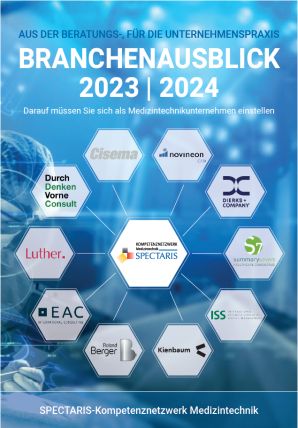
Ten outstanding management consulting firms with diverse areas of expertise, along with the medical technology sector within the German industry association SPECTARIS: This is the “SPECTARIS Medical Technology Competence Network,” which was launched in the summer of 2023 and will further strengthen the existing, long-standing, and successful collaboration.
This strong partnership is entirely dedicated to serving the approximately 130 German member companies—mostly small and medium-sized enterprises—in the capital goods and medical devices sector, which are characterized by a high degree of innovation and a strong focus on exports. In their day-to-day operations, manufacturers face a wide variety of operational and strategic challenges. At the same time, the medical technology market offers many opportunities and has enormous long-term potential. The competence network supports these companies by collectively sharing subject-specific and industry-specific knowledge to help them overcome these challenges and capitalize on the diverse opportunities available.
Medical Technology Competence Network: Industry Outlook 2023/24
Key Document: "Access to the German Reimbursement System"
A Guide for Manufacturers of Medical Devices and In Vitro Diagnostics

SPECTARIS, in collaboration with the associations BVMed, VDGH, and ZVEI, has developed a guide titled “Access to the German Reimbursement System” for manufacturers of medical devices and diagnostics as part of the joint working group on health technology assessment. The guide is intended to provide an overview of the reimbursement system of statutory health insurance plans in Germany. The guide’s basic module includes an overview of reimbursement pathways within the statutory health insurance system. In addition, there are four in-depth modules for a more detailed understanding:
The separate modules are available exclusively to our members on our member platform mySPECTARIS . |
Study: New Ways Out of the Supply Chain Crisis
Medical Technology Addresses Supply Chain Challenges with Agile Development Methods
The ongoing global supply chain issues have long been part of everyday life for German medical technology manufacturers as well. In a recent study by H&Z Management Consulting in cooperation with the German industry association SPECTARIS, more than three-quarters of survey and interview participants reported severely disrupted supply chains, coupled with significant cost increases and supply problems, particularly with electronic components. Many engineers are needed to find alternative components and suppliers and to modify product designs, as the previous components are no longer available. The demand for rapid product redesign is rising dramatically.
To address these challenges and avoid delays in the launch of new products, manufacturers are relying on proven measures while also exploring new approaches.
Study
Quality of Assistive Devices and Assistive Device Provision

For many years, the question has been raised as to how quality in the provision of medical aids can be measured. Defining these criteria for the quality of assistive device provision was the objective that led rehaVital Gesundheitsservice GmbH, the medical technology industry association SPECTARIS, and the bed manufacturer Burmeier to approach Bielefeld University of Applied Sciences to launch a follow-up study based on the 2021 InGeTec Delphi study, with the aim of further specifying these findings.
The study’s findings provide all stakeholders involved in the provision of medical aids with approaches for ensuring that, in the future, the provision of medical aids is targeted, accepted by insured individuals, cost-effective, and yet of high quality.
Target Vision
Vision for Medical Technology in 2025
“By 2025, Germany will have a research-intensive, high-performing, economically sound, and internationally competitive medical technology industry, whose companies develop and manufacture innovative products and successfully market them both domestically and internationally, thanks to the right framework conditions in Germany and the EU.”
Read the publication to find out what needs to happen in order to achieve this goal.
Statement of Commitment
Manufacturers of nursing beds

The SPECTARIS Expert Group on Nursing and Hospital Beds drafted a voluntary commitment to take ethical considerations into account in the development of nursing beds. The new declaration is based on the existing Care Charter, which sets forth the rights of people in need of assistance and care in eight articles. The Charter outlines quality standards, goals, and the rights of those in need of care, the fulfillment of which is essential to ensuring good care and support.
New Edition of the Brochure
Hygienic Processing of Respiratory Home Therapy Devices

The recommendations on the “Hygienic Reprocessing of Respiratory Home Therapy Devices” provide a more detailed elaboration of the recommendation issued by the Commission for Hospital Hygiene and Infection Prevention at the Robert Koch Institute (RKI) and the Federal Institute for Drugs and Medical Devices (BfArM) regarding the “Hygiene Requirements for the Reprocessing of Medical Devices” as they apply to the field of respiratory home therapy. The recommendations were developed by members of the Respiratory Home Therapy Division of the SPECTARIS Medical Technology Association with the support of competent and professionally qualified experts.
Hygienic Reprocessing of Devices Used in
Respiratory Home Therapy (03/2021)
SPECTARIS Trend Report
Medical Technology
Topic of the Medical Technology Trend Report: How Is the Pandemic Affecting the Medical Technology Industry?
Study
Digital Jobs in Medical Technology
The study “Digital Jobs@Medical Technology,” published in August 2020 by the German industry association SPECTARIS and the management consulting firm Kienbaum Consultants International, once again reveals the crossroads at which the German medical technology industry stands.
Whether growth potential is realized or the shortage of skilled workers holds the industry back depends on how companies handle digitalization. A detailed survey of more than 80 participants—mostly from executive management and human resources departments—already reveals a barrier to corporate growth due to a shortage of “digital experts”: Half of those surveyed believe their company could grow by up to 10 percent if the need for “digital experts” could be adequately met.
Based on the medical technology sector’s total revenue of 33.4 billion euros in 2019—the year before the pandemic—estimates suggest that revenue could have been nearly three billion euros higher.
More Information
Health 4.0 Study - Digitalization in the Healthcare Industry
Why Germany Must Become the Leading Market for the Digital Healthcare Industry and Medical Technology
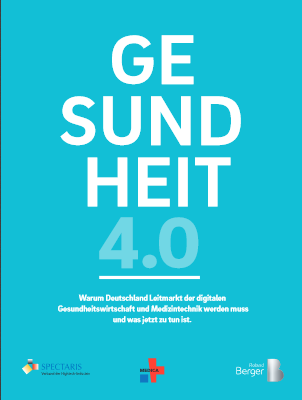
The digitization of the healthcare sector offers enormous opportunities: significantly better patient care, more efficient hospitals, new high-tech medical products, and new markets for the German medical technology industry. In that sector alone, digitization will create 10,000 additional jobs, and even more are possible if the framework conditions are improved.
However, the risks are just as great as the opportunities should Germany fail to keep pace with digitalization. Hospitals would fall behind internationally. Patients would receive poorer care than in neighboring countries. German medical technology companies would lose market share and be displaced by new competitors. The healthcare sector is one of the most important pillars of the German economy. If it begins to falter, the effects will be felt throughout the country.
On behalf of the industry association SPECTARIS and Messe Düsseldorf, Roland Berger surveyed more than 200 medical technology companies of all sizes for this study. The analysis also drew on numerous interviews with healthcare providers, startups, and policymakers, as well as an analysis of current relevant publications. The results show, however, that digitalization is gaining ground. The medical technology sector, for example—a central part of the healthcare industry—already expects revenues of around 15 billion euros by 2028 from new digital products and services, even under current conditions. That would then account for nearly one-third of the industry’s projected total revenue.
Your contact person

SPONSORSHIP OPPORTUNITIES IN THE MEDICAL TECHNOLOGY TRADE ASSOCIATION
Medical Technology Industry Profile
BIOCOM's Medtech Guide 2026

BIOVOM's *Guide to German Medtech Companies* covers the entire spectrum and value chain of medical technology products and healthcare services. It also highlights the latest developments in the industry.
What Our Members Say
SPECTARIS acts as a strong association that vigorously represents the interests of its members in the political, business, and social spheres.
“SPECTARIS acts as a strong association that vigorously represents its members’ interests in the political, business, and social spheres. As members, we have the opportunity to actively raise our concerns and help shape the agenda to ensure that our voice is heard in relevant political and social discussions. In addition, through SPECTARIS, we have access to a broad network of companies, experts, and decision-makers from the high-tech industry. This allows us to forge valuable contacts and leverage synergies. Through this exchange, we and other members can benefit from each other’s experiences and expertise.”
Frank-Martin Rammelt, Managing Director of seleon GmbH
Community makes us strong!
For us as medium-sized companies, the SPECTARIS association serves as a bridge between the government and our interests—our collective strength makes us stronger! We appreciate the very helpful continuing education program in the field of medical technology and benefit from the organization of a wide variety of delegation trips. Our membership in SPECTARIS also ensures that we receive regular updates on new regulatory requirements.
Maik Greiser, Managing Partner / CEO, ATMOS MedizinTechnik GmbH & Co. KG

A Voice for Medical Technology
For us as a medical technology manufacturer, SPECTARIS serves as an important voice in our dealings with policymakers. Especially in light of the current MDR, it is immensely important to have a strong and effective association to represent our interests. We are very satisfied with our collaboration and feel well represented.
Regina Kirchner-Gottschalk, Managing Director of KaWe – KIRCHNER & WILHELM GmbH + Co. KG
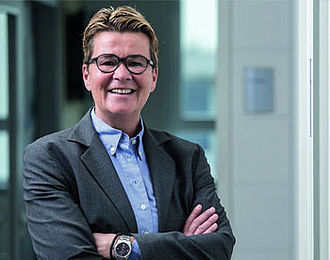
Innovation drives us forward
Demands are growing, markets are changing—but innovation opens up new paths for us. With digital progress, bold ideas, and modern processes, we are shaping the standards of tomorrow. As a SPECTARIS member, we leverage the strength of the network to actively shape the future in this dynamic environment.
Fabian Bohnen, COO / Stephan Börner, CEO, Ofa Bamberg GmbH

What we particularly appreciate about SPECTARIS is its technical expertise.
As a medium-sized medical technology company, Richard Wolf benefits greatly from SPECTARIS’s extensive network. We particularly value their technical expertise.
Management of Richard Wolf GmbH: Mr. Pfab, Mr. Steinbeck
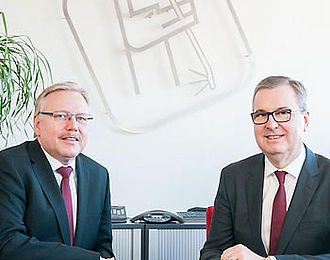
It's worth getting involved!
In times of rapid and far-reaching changes in the medtech industry and a challenging regulatory environment, SPECTARIS is an important partner for our company and plays an indispensable role as an advocate for our interests in Berlin and Brussels. It’s worth getting involved!
Bert Sutter, Managing Director, Sutter Medizintechnik GmbH

The medical technology industry is a highly diverse, dynamic, and innovative sector
The medical technology industry is a highly diverse, dynamic, and innovative sector that must adapt to constantly changing conditions. It faces significant pressure due, among other factors, to technological, regulatory, economic, and geopolitical shifts. As a medium-sized company, we are confident that, with SPECTARIS, we have a powerful industry association at our side that effectively represents our interests in the political arena and the public sphere, while also helping us successfully meet the challenges ahead through its expertise and an outstanding network of experts.
Monica Waskönig, CEO of Temena GmbH


