

EU Dual-Use Regulation

The European Union’sDual-Use Regulation (Regulation (EU) 2021/821)was recently amended and has been in effect since September 9, 2021. The new regulation replaces the previous Regulation (EC) No. 428/2009 from 2009. This marks the completion of the first comprehensive revision of the EU export control system since 2009.
In a joint online event, the Federal Office for Economic Affairs and Export Control (BAFA)—as the competent licensing authority—along with the DIHK and the IHKs provided information on the changes affecting companies and the practical implications of the new provisions of Regulation (EU) No. 821/2021.
You can access the BAFA's presentations on the BAFA website.
Further Information and Publications

The Commission adopted its legislative proposal to modernize the EU’s export controls on sensitive dual-use goods and technologies in September 2016. A revision of the 2009 regulation had become necessary to take into account technological developments, new security risks, and emerging technologies. After several years of trilogue negotiations, the Commission, the European Parliament, and the Council finally reached an agreement on a new text for the regulation in November 2020.
The new regulation incorporates numerous proposals from the Commission aimed at comprehensively improving the system. It is intended to make the EU's existing export control system more effective through the following measures:
- Introducing a new dimension of “human security” to enable the EU to respond to the challenges posed by new dual-use technologies—in particular, cyber-surveillance technologies—that pose a risk to national and international security; this also includes the protection of human rights;
- Updates to key terms and definitions (such as the definition of the term “exporter,” which now also includes individuals and researchers involved in the transfer of dual-use technology);
- Simplifying and harmonizing authorization procedures, as well as enabling the Commission to amend the list of goods or destinations subject to specific forms of control through a “simplified” procedure—that is, delegated acts—thereby making the export control system more flexible and better able to evolve and adapt to changing circumstances;
- Improving the exchange of information between the authorizing authorities and the Commission to ensure more transparent authorization decisions;
- Coordinating and supporting robust enforcement of controls, including improving the secure electronic exchange of information between licensing and enforcement authorities;
- Development of an EU capacity-building and training program for the Member States' licensing and enforcement authorities;
- Providing targeted information to industry and ensuring transparency toward stakeholders in order to build structured relationships with the private sector through specific stakeholder consultations conducted by the relevant Commission working group or experts from the Member States;
- Strengthening dialogue with third countries and working to ensure a level playing field at the global level.
The new framework enables the EU to take important steps to pool expertise and address specific challenges, particularly in the context of cyber surveillance (guidelines on due diligence are still being developed in this regard), but also with regard to emerging dual-use technologies in fields such as biotechnology, artificial intelligence, and advanced computing systems.
The regulation ensures greater transparency by increasing the level of consultation and reporting between the member states and the Commission and by promoting the development of a new EU platform for electronic authorization, which has already been tested in four EU member states.
It also provides a legal basis for EU actions at the multilateral, plurilateral, and bilateral levels — recognizing that the effectiveness of controls depends on the cooperation of the largest technology manufacturers — and builds on the existing multilateral framework for export controls, the Wassenaar Arrangement, which forms the basis for many of the restrictions introduced by the regulation at the EU level.
In addition, the European Commission has also published further information on the entry into force of the EU Dual-Use Regulation, which you can access here.
Further information:
Full press release
Text of the EU Dual-Use Regulation (Regulation (EU) 2021/821)
Memo – Implementation of the Regulation
European Commission information page: Control of trade in dual-use items
Agreement on New Rules for Trade in Dual-Use Items (Press Release, November 9, 2020)
EU Council Press Release: Agreement on New Rules for Trade in Dual-Use Items
EU Commission press release
European Parliament press release
Website on controls on trade in dual-use items

On September 8, 2021, the European Commission’s Directorate-General (TAXUD) published new codes for declaring dual-use goods in accordance with the new Dual-Use Regulation. The new codes are necessary to reflect the new legal framework. However, it will still take some time before they are implemented in ATLAS. Until further notice, therefore, the old codes should be used. The ITZ Bund has summarized the new codes in itsATLAS – Info 0218/21.

On September 9, 2021, the new EU Dual-Use Regulation (EU) 2021/821entered into force. The regulation modernizes the existing rules governing the control of exports, trade and brokering activities, technical assistance, transit, and transfers of dual-use items.
The key changes include, among other things, new licensing requirements for the export of certain digital surveillance goods if they are intended to be used in the recipient country for serious human rights violations [see Art. 5 of Regulation (EU) 2021/821].
In addition, new regulations have been introduced regarding technical assistance in connection with Annex I goods [see Art. 8 of Regulation (EU) 2021/821]. The EU regulation is supplemented in Germany by the national provisions in §§ 49 et seq. of the AWV, which already contained provisions regarding technical assistance. Further changes include stricter controls on brokering activities [see Art. 6 of Regulation (EU) 2021/821] and transit [see Art. 7 of Regulation (EU) 2021/821].
In addition, two new General Authorizations are being introduced: EU007 authorizes the intra-group transfer of software and technology for commercial product development. EU008 concerns the export of encryption goods. Iceland is also being added to EU001 as a privileged recipient country.
To mark the entry into force of the EU Dual-Use Regulation, the Federal Office for Economic Affairs and Export Control has also published two new fact sheets:
- The New EU Dual-Use Regulation (Regulation (EU) 2021/821)
- Fact Sheet on Article 5 of the New EU Dual-Use Regulation (Regulation (EU) 2021/821)
For export applications submitted before September 9, 2021, the relevant provisions of the former Regulation (EC) No. 428/2009 continue to apply [see Art. 31 of Regulation (EU) 2021/821].
This means that, in principle, these export applications will still be decided on the basis of the old Regulation (EC) No. 428/2009 even if the decision to grant the authorization is made after Regulation (EU) 2021/821 enters into force.
Export licenses issued prior to September 9, 2021, as well as information regarding the list of goods, remain valid. It is not necessary to submit a new application. Similarly, registrations for EU001–006 remain valid. Furthermore, it is not necessary to appoint a new export control officer. The relevant AV notices will be updated [publication in the BAnz to follow]. The notices regarding end-use declarations have already been updated [BAnz AT September 1, 2021, B6, B7]. These updates do not involve any changes to the content.
Amendment to the National Foreign Trade Law to Bring It into Line with the New EU Dual-Use Regulation

In the run-up to the entry into force of the Dual-Use Regulation, further amendments were made at the national level to the Foreign Trade Act (AWG) and the Foreign Trade Regulation (AWV). On August 25, 2021, the Federal Cabinet approved the regulation amending the Foreign Trade Act and the Foreign Trade Regulation, which had been submitted by Federal Minister of Economics Altmaier.
The First Ordinance Amending the Foreign Trade Act and the Foreign Trade Ordinance (1st AWG/AWV Amendment Ordinance) of August 25, 2021 (BAnz AT September 7, 2021, V1), references in the Foreign Trade Regulation (AWV) and the Foreign Trade Act (AWG) to the previously applicable Regulation (EC) No. 428/2009 are replaced by references to the new EU Dual-Use Regulation. In addition, the First AWG/AWV Amendment Ordinance contains provisions to treat Northern Ireland as part of the European Union for the purposes of applying licensing requirements. For reasons of legal clarity and legal certainty, the procedural provisions governing the export of goods are also clarified.
The changes took effect on September 9, 2021.
Revised Version of the Notice on General Export Licenses
With the notice regarding the use of Union General Export Authorizations Nos. EU001, EU002, EU003, EU004, EU005, EU006, EU007, and EU008, the Federal Office for Economic Affairs and Export Control (BAFA) has updated the previous notice on the use of General Export Authorizations to align it with the revised EU Dual-Use Regulation. Like the revised EU Dual-Use Regulation, the new notice on the use of EU General Export Authorizations will take effect on September 9, 2021. This notice updates the registration and reporting requirements for the use of EU General Authorizations and expands them to include the registration and reporting requirements for the newly introduced General Authorizations No. EU007 and No. EU008.
The familiar basic structures remain unchanged; in particular, exporters who are already registered to use AGGs No. EU001 through No. EU006 do not need to re-register for these AGGs. Instead, the BAFA will update the existing registrations.
All (national) general authorizations issued by the BAFA (with the exception of General Authorization No. 28) have also been amended [BAnz AT Aug. 31, 2021, B5–B9; BAnz AT Sept. 1, 2021, B5; BAnz AT Sept. 6, 2021, B4]. In addition to updating the references to the new EU Dual-Use Regulation, the exclusion criteria for all AGGs—again with the exception of AGG No. 28—have been expanded to include the intended uses specified in Article 5 of Regulation (EU) 2021/821.

As an EU member state, Austria is subject to various licensing, reporting, and notification requirements. For example, a license from the BMDW (Federal Ministry for Digital and Economic Affairs) is required for listed dual-use goods, and in some cases, this requirement also applies to intra-Community transfers.
The competent authority is theFederal Ministry for Digitalization and Business Location (BMDW), Department III/2 – Export Control
Email:post.III2_19@bmdw.gv.atorexportkontrolle@bmdw.gv.at
Phone: 01/711 00-0
Further information:
Information from the Austrian Chamber of Commerce
SPECTARIS Activities Regarding the Amendment of the EU Dual-Use Regulation
On September 28, 2016, the European Commission presented a proposal for a new EU Dual-Use Regulation, which is intended to replace the currently applicable Regulation (EC) No. 428/2009. This regulation is one of the most important pieces of legislation governing European export controls and must be strictly observed by all European companies that deal in goods or technologies that can be used for both civilian and military purposes.
SPECTARIS member companies have an average export ratio of over 60 percent. This legislation is therefore of extraordinary importance to most of these companies. To protect the interests of its members, SPECTARIS is actively and constructively participating in the legislative process.
May 2017
SPECTARIS Statement
June 2017
SPECTARIS Statement (English)
Your Contact Person

What Our Members Say
SPECTARIS acts as a strong association that vigorously represents the interests of its members in the political, business, and social spheres.
“SPECTARIS acts as a strong association that vigorously represents its members’ interests in the political, business, and social spheres. As members, we have the opportunity to actively raise our concerns and help shape the agenda to ensure that our voice is heard in relevant political and social discussions. In addition, through SPECTARIS, we have access to a broad network of companies, experts, and decision-makers from the high-tech industry. This allows us to forge valuable contacts and leverage synergies. Through this exchange, we and other members can benefit from each other’s experiences and expertise.”
Frank-Martin Rammelt, Managing Director of seleon GmbH

Together, we are strong.
Together we are strong—That is why we value the strong network and the open and excellent collaboration within the association, which allows us, as one of the leading manufacturers, to work together on solutions to the modern challenges in the contact lens industry, to collaborate on joint campaigns, and to capitalize on identified trends.
Johannes Zupfer, General Manager for Germany, Austria, and Switzerland, CooperVision GmbH

Advancing Photonics
Photonics is one of the most innovative key industries and places high demands on the organizations that represent its interests. SPECTARIS meets these demands in a compelling manner. As a strong industry association, SPECTARIS effectively represents the interests of its members in the political, business, and social spheres, while also promoting exchange and networking within the industry. We thank SPECTARIS for this commitment and greatly value our trusting collaboration.
Dr. Ralf Kuschnereit, JENOPTIK AG

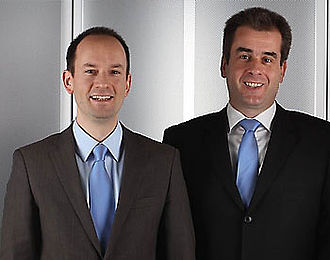
OBE relies on high-quality products “Made in Germany.”
OBE relies on high-quality products “Made in Germany.” Thanks to innovation and automation, spring hinges and security screws can be manufactured in large quantities at the Ispringen facility. This goes hand in hand with increased productivity and a division of labor for simple products at our facility in China. In this way, we secure jobs in Germany.
Peter Specht / Erik Schäfer - Managing Directors, OBE
Community makes us strong!
For us as medium-sized companies, the SPECTARIS association serves as a bridge between the government and our interests—our collective strength makes us stronger! We appreciate the very helpful continuing education program in the field of medical technology and benefit from the organization of a wide variety of delegation trips. Our membership in SPECTARIS also ensures that we receive regular updates on new regulatory requirements.
Maik Greiser, Managing Partner / CEO, ATMOS MedizinTechnik GmbH & Co. KG

The association offers services that are perfectly tailored to our needs.
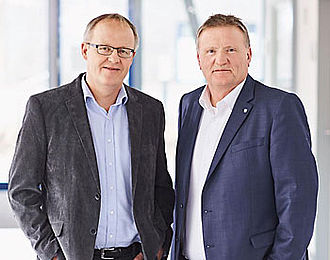
Our industry association, SPECTARIS, is a strong advocate for the interests of medium-sized, owner-managed companies like ours. It is just as important to us that the association provides a platform for open dialogue among member companies and offers services—such as industry reports and events focused on specific topics—that are perfectly tailored to our needs.
Managing Partners of Jüke Systemtechnik GmbH, Martin Hovestadt (left) and Heinrich Jürgens (right)
A Voice for Medical Technology
For us as a medical technology manufacturer, SPECTARIS serves as an important voice in our dealings with policymakers. Especially in light of the current MDR, it is immensely important to have a strong and effective association to represent our interests. We are very satisfied with our collaboration and feel well represented.
Regina Kirchner-Gottschalk, Managing Director of KaWe – KIRCHNER & WILHELM GmbH + Co. KG

Innovation drives us forward
Demands are growing, markets are changing—but innovation opens up new paths for us. With digital progress, bold ideas, and modern processes, we are shaping the standards of tomorrow. As a SPECTARIS member, we leverage the strength of the network to actively shape the future in this dynamic environment.
Fabian Bohnen, COO / Stephan Börner, CEO, Ofa Bamberg GmbH

What we particularly appreciate about SPECTARIS is its technical expertise.
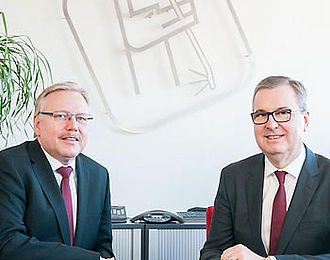
As a medium-sized medical technology company, Richard Wolf benefits greatly from SPECTARIS’s extensive network. We particularly value their technical expertise.
Management of Richard Wolf GmbH: Mr. Pfab, Mr. Steinbeck
It's worth getting involved!
In times of rapid and far-reaching changes in the medtech industry and a challenging regulatory environment, SPECTARIS is an important partner for our company and plays an indispensable role as an advocate for our interests in Berlin and Brussels. It’s worth getting involved!
Bert Sutter, Managing Director, Sutter Medizintechnik GmbH

We want to be a trusted partner for our laboratory customers, both today and in the future.
SPECTARIS’s in-depth information on industry and technology trends, as well as the regulatory landscape, is just as important to us as its advocacy work in Berlin and Brussels. The dedicated SPECTARIS team is always a great point of contact for us.
Dr. Christoph Schöler, Managing Partner, BRAND GMBH + CO KG, VACUUBRAND GMBH + CO KG

A voice for the industry
In a diverse and specialized industry such as analytical technology—which is highly technical and subject to numerous regulatory requirements—small specialists compete with large technology conglomerates. SPECTARIS succeeds in uniting the interests of all its members and serves as the industry’s collective voice and advocate.
Albrecht Sieper, Managing Director of Elementar Analysensysteme GmbH

SPECTARIS is the ideal platform.
SPECTARIS provides us with the ideal platform for constructive dialogue with member companies and serves as a reliable voice for the laboratory industry in the realms of politics and science.
Dr. Gunther Wobser, Managing Partner of LAUDA DR. R. WOBSER GMBH & CO. KG

SPECTARIS fosters collaboration in our industry.
“The very informative discussions at SPECTARIS in Berlin and here at our office convinced me of SPECTARIS’s commitment and the quality of its work. In particular, the opportunity to combine topics from analytical, biotechnology, and laboratory technology with the field of medical technology is very interesting for Sigma,” I wrote upon joining in 2011. This has been confirmed, and today we are actively involved in several working groups.
Dr. Michael Sander, Managing Director of Sigma Laborzentrifugen GmbH

National advocacy group puts the spotlight on the industry
Laser Components benefits from the industry association in a variety of ways. As a company, we value the broad exchange of information within the working groups—whether in human resources, marketing, or export control, customs, and foreign trade practices. For our industry, Spectaris also serves as a political voice—the Photonics Trade Association not only maintains constant communication with the BMWi and BMBF ministries but also provides information on European initiatives.
Patrick Paul, Managing Director of LASER COMPONENTS GmbH

A Voice for Innovative Small and Medium-Sized Businesses
In the century of the photon, we need an advocacy group that is both strong and responsive. For us, as providers and consultants for the most innovative products on the global photonics market, this institution is particularly important. We know our interests (e.g., in the area of foreign trade) are in good hands, and we can focus on what matters most: satisfying our customers.
Andreas Börner, Managing Director of Laser 2000 GmbH

Our membership in the SPECTARIS industry association is of great value to us.
It not only gives us access to a strong network of leading companies across various high-tech industries, but also provides an important platform for professional exchange and continuing education. In addition, we benefit from the association’s strong advocacy with policymakers, the business community, and society at large, which plays a crucial role in creating a sustainable framework for the future. Through our membership in SPECTARIS, we can contribute our expertise, address current developments at an early stage, and jointly drive innovation and sustainable growth.
Frank Billhardt, Division Laser Protection EMEA, LASERVISION GmbH


